On the Power of Sartorial Signs

This is an image published on the Twitter account of … let’s go with ‘the President of the United States’.

KKW

As any picture, it tells a story, yet precisely what this story is about is, as always, a matter of interpretation. An interpretation that in this case revolves around the knowledge and understanding of sartorial code and signifiers. To be able to read and interpret the latter provides a very different meaning of this image than an interpretation that misses code and signification.

An example of the latter reading is provided by Libby Torres of ‘The Daily Beast’. For her, the image expresses that ‘Kim Kardashian got played by Trump’, that her attempt to discuss one of the most egregious cases of mandatory sentences in the US justice system simply turned into a photo-op for ‘the President of the United States’. Ms Kardashian-West’s purpose for the visit to the White House was to ask for a pardon for Alice Marie Johnson, a first-time non-violent drug offender serving a life sentence. A worthy cause, if ever there was one.

For Torres, the meeting becomes a ‘sly publicity stunt’ for ‘the President of the United States’, ‘in the end she was nothing more than a prop in Trump’s ongoing efforts to get A-list celebrities to endorse him’. Most of the media reported on the meeting with similar disdain, frequently playing on Ms Kardashian-West’s first name and its similarity to the last name of the leader of the Democratic People’s Republic of Korea. Sometimes clever, more often sexist and dumb, as it was to be expected from the relevant media.

Let’s have another, closer, and more careful look at the picture and what Ms Kardashian-West is wearing in the photo. It requires a bit of enlargement and some knowledge of fashion houses, but what becomes visible is part of the brand name ‘VETEMENTS’ stitched across her crotch, just above the top of the desk.

Enlargement


What does this brand name signify? As Morwenna Ferrier explains in The Guardian,

Vetements is a hip fashion collective, overseen by Demna Gvasalia, a Georgian designer who is well known within the industry for creating meme-friendly clothes at surprisingly high prices, heavily imbued with irony.

And for VOGUE, ‘Part of the genius of Demna Gvasalia’s Vetements is its appropriation and refinement of mass culture into tongue-in-cheek garments’.

So Vetements is for all intent and purpose a fashion house the products of which play with and undermine the hierarchy between high and low culture. It thereby denies any recognition of authorities that depends on such hierarchy – among them, the authority of ‘the President of the United States’, who himself has done much to undermine the authority of the office he holds.

For Ferrier, therefore, wearing Vetements becomes a moment of ironic resistance, a gesture that subtly and sublimely denies ‘the President of the United States’ what he seeks to gain from this photo op. ‘Once you’ve seen [the words across her trousers], the joke lands squarely on Trump – it is, arguably, the sartorial equivalent of doing bunny ears behind his head’.

The point here is not to settle the question which interpretation is correct or more plausible. Rather, I would like to point out that proficiency in sartorial code – on the part of those producing the relevant signifiers as well as on the part of those expected to competently read them – would expand our space for political action. And perhaps we would acknowledge the possibility that in this image, the hierarchy of cultural competence is reversed, and that the ‘gleeful, cunning grin’ betrays nothing but ignorance of its wearer. In Ferrier’s words, ‘Only Kardashian-West could use a meeting at the White House to trump Trump. And judging by his face, he had no idea what was going on next to him’.


What (Not) to Wear as a Political Actor

In a recent article one of my favourite fashion writers, Robin Givhan (WP), reflects upon the sartorial codes of the civil rights movements of the 1960s. It has been 50 years since Martin Luther King organised the ‘Poor People’s Campaign’ and gave perhaps his most moving address, ‘I’ve been to the mountain top’ (excerpt), seemingly anticipating what would happen the next day. On 4 April 1968, tragically, King was assassinated in Memphis TN.

Givhan focuses on the way MLK and his allies and followers dressed in their marches in the American South and compares and contrasts their style to the ‘uniforms’ worn by the Black Panthers in the northern cities of the USA. She notes the neat and conservative, in a sense ‘bourgeois’ vestiary code employed by the former group and the more military-inspired code of the latter group.

About MLK and his associates she writes,

They were not fighting to escape the system; they were working to become fully integrated into it. […]

These upright men, women and children countered the narrative that black people were subpar exotics by dressing with man-next-door polish. Their message, tactics and style were precisely detailed. […]

The civil rights warriors did not dress in battle gear. In adhering to their philosophy of nonviolence, their style was conciliatory rather than confrontational. These were not clothes for a fight but clothes for a gentlemanly — or ladylike — negotiation.

And about the Black Panthers,

The Black Panthers were not conciliatory in their methods. Their dress didn’t suggest a desire to assimilate or fit in. Instead, their berets and leather jackets, tunics, dashikis, Afros and heavy beards were pointedly outside the realm of suburban conventions, flower-child mysticism and churchgoing decorum.

Thee ‘strikingly different fashion postures, from the suited-up members of a movement that had been nurtured in the black church [in the South] to the black-leather-clad Black Panthers who mostly worked from urban storefronts [in the North]’, their fashion choices reflected and reinforced their respective approaches to political agency.

‘Their clothes not only identified their approach, they were also essential to it. Southern blacks were negotiating for rights. Those in the North were fighting for power’.

W425-30(LBJ library via Wikimedia Commons)

BlackPanthers(Screenshot, National Archives)

As Givhan notes, this sartorial formality, in which a particular uniform dress code becomes part of the constitution of political agency, is very much absent today. ‘Today, fashion is less adept at delineating between insiders and outsiders, between the establishment and the rebels. Everyone wears jeans and T-shirts, sneakers with their suits’. And pointing to the ‘March for Our Lives’ (which I discussed in a previous entry), she points to fashion as a way to empower the individual. ‘Fashion still has the capacity to agitate, but as an independent act of aesthetic defiance’. In my entry, I briefly discussed the appearance of Emma González in her torn jeans, camouflage jacket and close-shaven head. And I maintain that this is one of the images that define the agency of the students that organised this march. But there is another angle to the story that Givhan alludes to in her very last paragraph. ‘The inequities were obvious in 1968. Modern fashion has made room for all the tribes. But that is not to say that they are equal’.

So I am wondering: to what extent has fashion become ideological? To what extent does it produce an individuality that is supposed to be at the centre of our creativity and agency, yet at the same time deprives us of these capacities and thereby masks persistent differences in power and privilege? Politics, or the Political, to employ a broader concept, is about the social and collective realm, not the individual one. The Political structures and determines the lives of collective identities, such as women, students, African-Americans, immigrants, and so on. The ‘uniform’ vestiary codes of MLK of the Black Panthers recognise the need to form a recognisable collective identity that constitutes the possibility of political agency. According to Givhan, for MLK and his associates, the desire for integration and equal rights was expressed in wearing the suits of the society that had rejected them so far; for the Black Panthers, their uniforms set them apart from a society that was to be challenged in a different, antagonistic way.

Yet fashion today reflects and contributes to the (neo-liberal) individualisation of late-modern Western society. We are expected to express our own interests and needs, act on our own behalves and express our identity in our own creative manners. Yet oddly enough, as modern individuals, we seem incapable of living up to this liberal ideal. As Andrew Hill analyses in his sardonic essay ‘People Dress so Badly Nowadays: Fashion and Late Modernity’ (in C. Breward and C.Evans [eds.], Fashion and Modernity, Berg 2005) ‘sartorial expressiveness, richness and heterogeneity’ are blatantly absent even from the streets of London, one of the world’s foremost fashion metropoles.

Oxford_Street_December_2006(Copyright Ysangkok via Wikimedia Commons)

As he observed on a grey November day on Oxford Street, ‘the people were dressed in highly similar clothes, with the same preponderance of plain, dark colours, and the same mixture of unremarkable casual wear’. Looking at the image above, one can easily agree with him; with the only specks of colour provided by London busses and traffic lights. And I can certainly claim that I already know what I shall encounter in Washington, DC during the summer there, above all when it comes to male dress code: T shirts declaring an allegiance to a brand, sports team, or alma mater, khaki cargo shorts and sneakers/trainers or, worse, flip-flops.

 Fashion, Hill argues, has become individualised and thus made ‘casual’, worn for comfort and convenience. It does not signify any social norms or standards and thus dissociates itself from any social or political cause. Casual fashion, he writes,

relates to much more than what people wear. We can see it as a process changing social relations across Western societies. Older hierarchies, rituals, and formalities have been marginalised as people have turned from them to embrace a casual, laissez-faire attitude to sociality […]

Durkheim identified this version of loss of meaning as an anomie afflicting modern societies – a state of meaninglessness, directionless and pointlessness. If anything goes, does anything really matter?

Arguably, fashion reflects, and via its visualisation realises and contributes to, this casualisation and individualisation of late-modern Western society (as Margaret Thatcher once claimed: ‘there is no such thing as society’) that undermines the political agency of social collectives and their ability to address systemic and structural differentials of power and privilege.

Lest I be misunderstood: my critique of Liberalism does not place me in the camp of ‘Republicans’ in the USA, or ‘Tories’ in the UK. Far from it. The uses and abuses of the term ‘liberal’ have very effectively masked the neo-liberal ideology both political parties have subscribed to since the 1980s. Also, in no way does my critique of the anomie of modern Western society mean that I wax nostalgically about, say, the 1950s, when social norms and hierarchies were well established, and men and women dress according to the socially approved sartorial codes of the day. I whole-heartedly support the progress that ‘women’s liberation movement’, the civil rights struggle of the African-American community, the protests of the LGBT community and others have made since then. My point is precisely this: how can we sustain the political agency of these (and emergent) communities in the age of neo-liberal individualisation? And can fashion contribute to the formation of collective social identities that re-ignite a struggle against ever more rigid social norms and standards, above all in the USA? Does wearing a ‘pussy-hat’ or donning the Handmaid dress do this, or do these sartorial items construct a community only ‘for the occasion’, for that demonstration or march? What sartorial code could create a community beyond the ephemeral experience of a march or a demonstration? How do we signify a progressive political programme, be it for women’s rights, or for students, literally marching and fighting for their lives? How can we mobilise sartorial codes that create communities that are more than the sum of their individual parts?

That this is still possible and politically relevant is demonstrated by neo-Nazis and alt-right groups, who have chosen Polo shirts as their new collective uniforms.
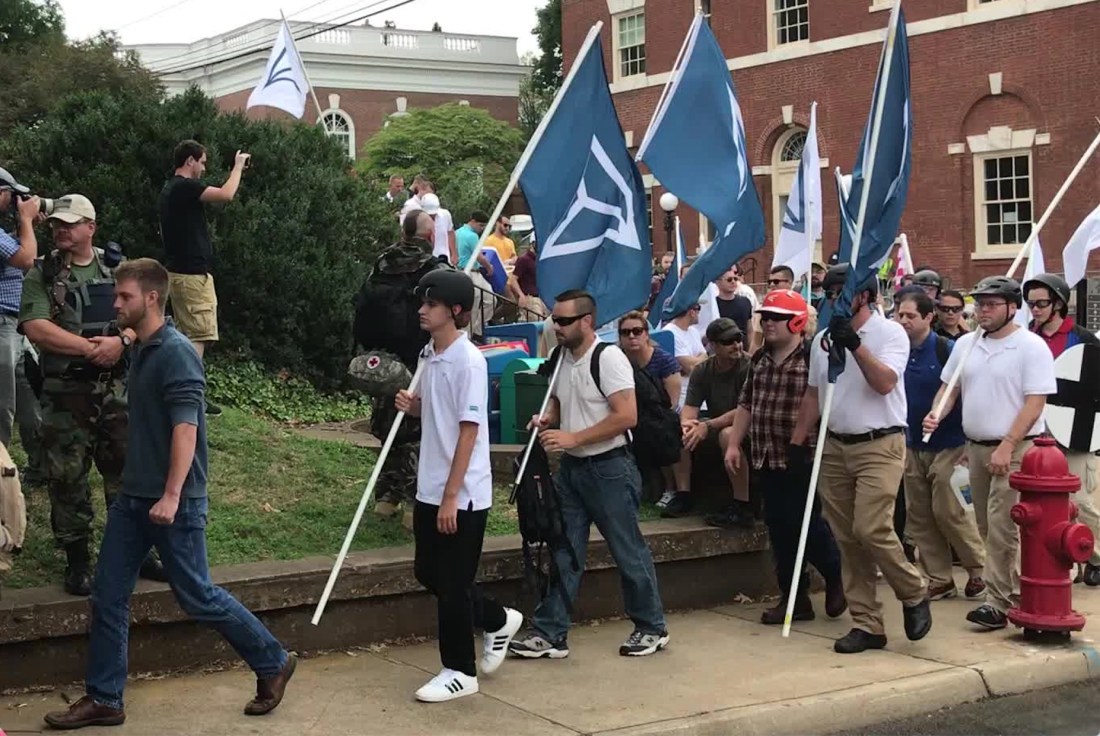
Charlottesville(Copyright Anthony Crider via Wikimedia Commons)

The purpose of this strategy is fairly clear: to normalise right-wing ideology and make it dis\appear in the cultural mainstream. Sartorial competence seems more relevant than ever in today’s political contestations. Progressive groups, I’d argue, must not cede this to their enemies.

How to Fashion a Monarchy: Signifying a Popular Future or an Imperialist Past?

Well, the dress was everything and more. It did transform an American actress into a British duchess, and it became an object of acclamation for the crowds present at Windsor or watching from afar on TV sets around the world. As explained on royal.uk, the gown was designed by Clare Wraight Keller, the artistic director of the House of Givenchy from Birmingham, UK.

True to the heritage of the house, the pure lines of the dress are achieved using six meticulously placed seams. The focus of the dress is the graphic open bateau neckline that gracefully frames the shoulders and emphasises the slender sculpted waist. The lines of the dress extend towards the back where the train flows in soft round folds cushioned by an underskirt in triple silk organza. The slim three-quarter sleeves add a note of refined modernity.

‘Givenchy’ is of course a signifier for a trans-Atlantic relationship that refers to Hollywood elegance that draws on European refined designs. It references the simple elegance of Audrey Hepburn in a little black dress in Breakfast at Tiffany’s – and, even more apropos, a wedding dress in Funny Face. The choice of a Givenchy wedding dress acknowledges Meghan Markle’s own Hollywood past and translates it into the sublime glamour she injected so successfully into the staid rituals of the British monarchy. I shall not comment here on the other African-American elements that made the ceremony thoroughly enjoyable and unpredictable; after all, this blog is about the politics of fashion.

As my favourite fashion writers agree, the dress served one purpose only: to introduce Meghan Markle and her extraordinary personality to the British monarchy and to the British people. While Kate Middleton recognised the historicity of the monarchy by indexing Victorian elements of style with her (still fab) Alexander McQueen dress, Markle’s dress referenced only herself, her presence in the present. Writes Vanessa Friedman (NYT),

It was not a Cinderella choice, not one that spoke of fantasy or old-fashioned fairy tales, but one that placed the woman proudly front and center. It underscored Ms. Markle’s own independence by divesting her of frippery, while also respecting tradition and keeping her covered up.

Her walk down the aisle, unaccompanied for most of it, only added to the sublime effect. Prince Harry was right, she looked amazing. Even in the official pictures released by Kensington Palace, she stands out, in the centre, and as the centre of the Royal Family, an ‘antibody’ to the slow decay and descent into irrelevance of the latter.

DduLpyHVMAAPvP1

DduLuGpU0AEyexk(Kensington Palace via @kensingtonroyal)

So this then is the politics of the Duchess of Sussex’ fashion choices: to provide a sartorial element that supports the popular acclamation of the monarchy and its apparently willingness to include a rather unconventional personality (I shall write more about acclamation in a future blog entry). Not everything is about the dress, but it certainly amplified her message and provided a focus for popular approval. It was apparently a very personal choice in cooperation with Ms Waight Keller, so we can safely assume that it expressed a very consciously chosen message. I look forward to reviewing the Duchess’s future sartorial choices, hoping she will escape some of the dodgy choice of the Duchess of Cambridge.

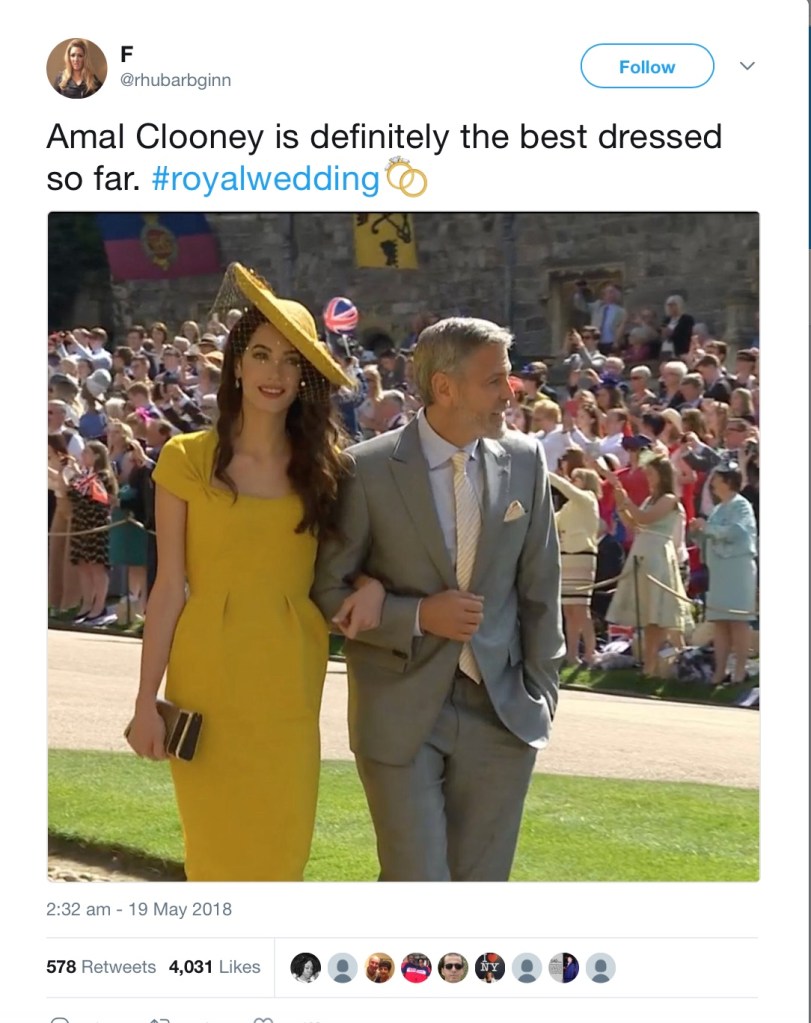
If I sound like a fan boy here, well, that’s because I am. This was simply an amazing sartorial performance as part of an even more stunning ceremony. I live in both the USA and the UK, and I admit to a certain level of glee to see African-American culture and sartorial ‘fabness’ injected into the rigidly codified and regulated British traditions. Perhaps the jazzed-up Britishness was best presented by Amal Clooney, a Lebanese-British barrister, married to a Hollywood actor (he cleaned up nicely too) and dressed in a gorgeous saffron-coloured dress by Stella McCartney. I am not the biggest fan of Ms McCartney’ designs, but this dress, together with the fascinator, was stunning.

Amal Clooney(rhubarbginn)

Alas, I would be remiss not to mention the dissident voices that address the politics of Ms Markle’s sartorial performance from a very different angle. Rather than acclamation, these voices offer a post-colonial critique of the symbols used in the dress. The latter are explained in the official statement of Kensington Palace:

Ms. Markle expressed the wish of having all 53 countries of the Commonwealth with her on her journey through the ceremony. Ms. Waight Keller designed a veil representing the distinctive flora of each Commonwealth country united in one spectacular floral composition.

The Commonwealth family of nations – of which Her Majesty The Queen is Head –will be a central part of Prince Harry’s and Ms. Markle’s official work following   His Royal Highness’s appointment as Commonwealth Youth Ambassador. Ms. Markle wanted to express her gratitude for the opportunity to support the work of the Commonwealth by incorporating references to its members into the design of her wedding dress.

There is a different interpretation available, one that points straight to the role of violence, power and exploitation in the history of current political order. Writes Aparna Kapadia,

Missing in the commentary was what seems to be an obvious point– the arrogant representation of 53 Commonwealth countries is a celebration of colonial rule. Another reminder, if one was needed, that the true reckoning of the unfortunate history of colonialism in Britain is far away. It is important to restate what that was – a violent period of centuries when the hapless Commonwealth, nearly 25% of the world, suffered under an extractive alien power’s rule.

Significantly, to celebrate a hand-made garment in praise of the Commonwealth raised some issues in India.

When India was a colony of England, Indian weavers saw a downturn in their business. The Calico Acts of the early 1700s effectively banned the import of most cotton textiles into England, many of which came from India.

And further,

From this time, until India’s Independence in 1947, the Indian artisan and weaver’s livelihood and skills were systematically destroyed. It was no accident then that Gandhi chose the charkha, the Indian weavers’ basic cotton-spinning tool, as the symbol of India’s struggle for independence.

Kapadia’s article resonated in India via social media. And it does raise an interesting and deeply problematic point. What happens when we re-appropriate and aestheticise violent pasts for the sake of contemporary acclamation and legitimation?

For a number of reasons, mostly related to the inability to speak for ‘the Other’  I am in no position to offer a conclusive answer here. From a critical theoretical perspective from within Political Science I would point to the continuous and ubiquitous presence of structures of power, violence and exploitation, of which colonial domination is but one, albeit a historically crucial and central one. Does that history dominate and determine the present and the future? Is India still a ‘former British colony’? Or has enough time past, as some commentators suggest, to declare another form of independence?

Again, I am in no position to offer even a tentative answer to these questions. But I note with some delight that Ms Markle’s fashion choices opened up, if inadvertently, a space for critical reflection on the problematic colonial past of this peculiar country. The fact that she, as a ‘mixed race person’ does this representing the subaltern voice in American culture adds yet another fascinating twist to the politics of fashion.

P.S. The person I admired the most in the ceremony was neither ‘royal’ nor ‘Hollywood’. Yet the Oscar de la Renta dress she wore was beautifully emphasising her regal and dignified personality.

Mother

Love and Marriage in the House of Windsor

Tomorrow is finally the day that many Royalists and Fashionistas have been looking forward to: the marriage of Henry Mountbatten-Windsor and Ms Rachel Meghan Markle, better known as Prince Harry and Meghan Markle.

I find the media frenzy surrounding the event interesting in its own right; perhaps it is a case of escapism in these troubled times, a bit of a romantic fairy tale of a prince and a fair maid that finally find each other (and in the process turn a rake into a Prince Charming) and will live happily ever after in the glaring spotlight of the media.

There is a bit more to this story, of course. Ms Markle is American, divorced, and above all ‘bi-racial’ (an awkward term that suggests some discontinuity within her personality), that is to say, she is the daughter of a ‘Caucasian’ father and an African-American mother. What this means to her and how it defined her life she put into an eloquent essay published in Elle magazine in 2015. As Harry’s bride and future member of the Royal Family, her ‘racial’ identity becomes a socio-political signifier that refers to a recognition of racial identities in a British society that to this day has evaded, avoided, and sometimes flat-out denied racism as a problem in the UK.

I admit I am looking forward to the broadcast which I shall have the pleasure of watching in the presence of my mother – a fashionista in her own right. I expect some interesting comments.

Here is what I am interested in: how will Ms Markle’s wedding dress compare to Sarah Burton’s stroke of genius of Katherine Middleton’s wedding dress in 2011 that combined a McQueen touch for Victorian Goth with a modern aesthetics? It combined the relevance of  the monarchy’s tradition with its current role in UK society. Will Ms Markle’s dress signify the ‘difference’ that her ‘racial’ identity makes?

Lest I be misunderstood, my interest is of course strictly academic While I shall indulge in the frivolity of royal spectacle and spectacular fashion, this event feeds into a nascent project on Power and Glory, building on Giorgio Agamben’s work on The Kingdom and the Glory.

61p+0YR8aAL._SX331_BO1,204,203,200_


Governance, the argument goes, requires and refers to an excess of aesthetics for its legitimation. So maybe the spectacle at Windsor tomorrow should be understood as a moment creating space for ‘public acclamation’ for the monarchy and thus for the legitimacy of the British governmental system.

But yes, above all: what dress will Meghan Markle wear…

On Wearing A Qipao to the Prom

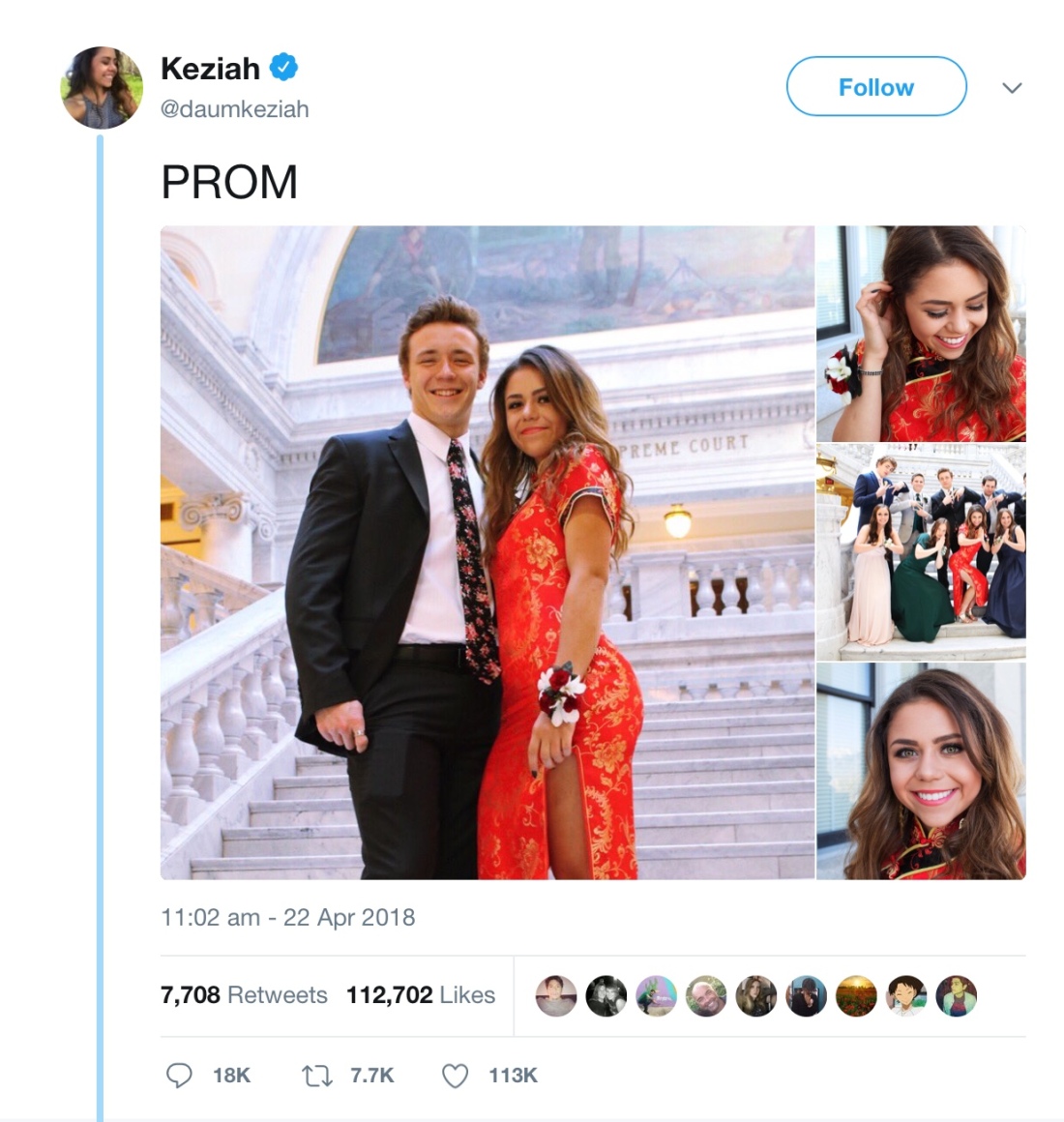
A recent Twitter storm brought back to the headlines the issue of how we relate to the culture of others. At the centre of this virtual melee was Ms Kezia Daum, a high school student from Salt Lake City, UT, who decided to wear a Chinese red cheongsam dress (also known as a qipao) she found in a vintage shop, to her high school prom in April of this year.

daum

What happened next is perhaps all too predictable today: a barrage of criticisms, attacks and condemnations, all accusing her of ‘cultural appropriation’. Daum, who is not Chinese, the argument goes, is banned from wearing this dress, as doing so allegedly insults the cultural sensitivities of Chinese people. Accusations of ‘consumerism’ blend with those of ‘colonial attitude’ to create a rather toxic discourse about fashion, culture and vaguely formulated ideas about authenticity.

Continue reading “On Wearing A Qipao to the Prom”

First Monday in May

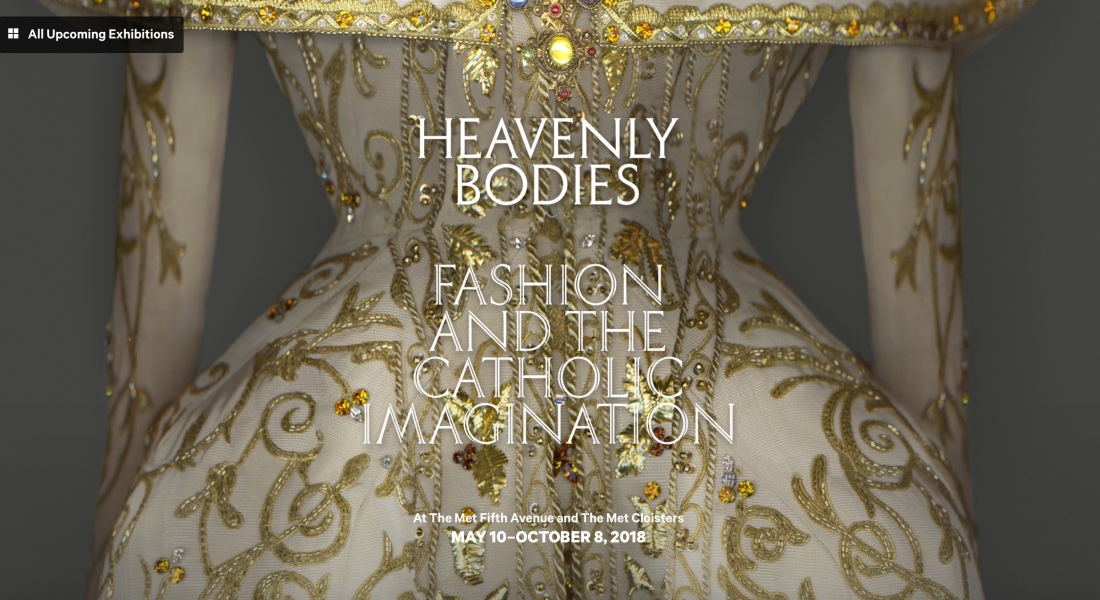
It’s that time of year again for the annual Met Gala, or as it is more formally known, The Costume Institute Gala at New York’s Metropolitan Museum of Art. The Gala centres on the theme of the year’s respective Fashion Show; this year, it’s Heavenly Bodies (see below).

Vogue’s slide show of the event seems to be the most extensive one (although it misses Stephen Colbert and Jimmy Fallon’s channelling of Zoolander).

There are lots of crosses, cardinal capes, halos and tiaras (with Rhianna and Sarah Jessica Parker taking the crown (pun intended), a few angelic outfits, and some guests that didn’t seem to have gotten the memo (Jaden Smith apparently showed up at the wrong event).

I shall write more about the exhibition once I had a chance to see it. For now, I admit quite liking the Gala’s red carpet, at its best moments, it nicely deconstructed Catholicism dogma by prioritising its aesthetic over its dogmatic elements. Perhaps the exhibition is able to turn the tables on fashion and reveal the dogmatic elements behind its aesthetic plays.

Forthcoming: Heavenly Bodies

“>HeavenlyBodies

After two rather underwhelming exhibitions at the Met, this promises to be another ‘must see’ event for fashionistas. The promotional video leaves me unimpressed, though. There is more to explore than what Andrew Bolton mentions here: what do the catholic signifiers refer to? Do they make fashion ‘sacred’? Or does the ‘fashioning’ of Catholicism make religion profane, perhaps even commodifies it? But perhaps this will be addressed in the catalogue after all. The exhibition on China in the Looking Glass three years ago gives me hope that Bolton will be able to tease out the philosophical and political aspects of this exceedingly fascinating relationship. Only a few more days to go until the Grand Opening and the Gala. I wonder what all the stars will wear on the red carpet.

Fashion Diplomacy Returns to Washington, DC

Being the only scholar to have developed a full theory of Fashion Diplomacy in The International Politics of Fashion (see right), I would be remiss not to write an entry about the recent state dinner, Melania Trump and the return of fashion diplomacy to the nation’s capital, Washington, DC.

The basic argument in my chapter on Marie-Antoinette and Michelle Obama states that since the former’s reign, it is the task of the ‘queen’ or ‘first lady’ to provide splendour and glory for sovereign power, and that Ms Obama’s fashion diplomacy gave a sartorial expression to the particular ‘imperial sovereignty’ (a concept I borrow with due apologies from Hardt and Negri) of the USA. Ms Obama had a particular predilection for wearing gowns at state dinners that were created by ‘hyphenated American’ designers, i.e., designers born in the country honoured at the dinner, but living and working in the USA to realise their full creative potential. If I may quote myself: ‘the creativity and talent of foreign national is rightfully appropriated by the USA, as this move is the condition under which [their] potential can be fulfilled in a globalized (fashion) world’. The culture, aesthetics and traditions of the designers’ countries of origin therefore become but reservoirs or portfolios to be fully realised by a New York-based fashion industry that turns their designs into globally recognisable products. This, my argument goes, is a sartorial expression of the character of US sovereignty that is inclusive and expansive rather than exclusive and limiting. ‘Wearing gowns by other country-American designers symbolizes and authenticates the inclusion and absorption of their spaces of origin into the globalizing American space’.

The one significant exception to this fashion policy was the red silk organza dress by the fashion house of Alexander McQueen that Ms Obama wore for the Chinese state dinner in January 2011. China, this fashion diplomacy suggested, cannot be absorbed by the US; it defines its own increasingly significant role in the global fashion industry as well as in global politics.

Barack_and_Michelle_Obama_welcome_President_Hu_Jintao_of_China,_2011Copyright: The White House via Wikimedia Commons

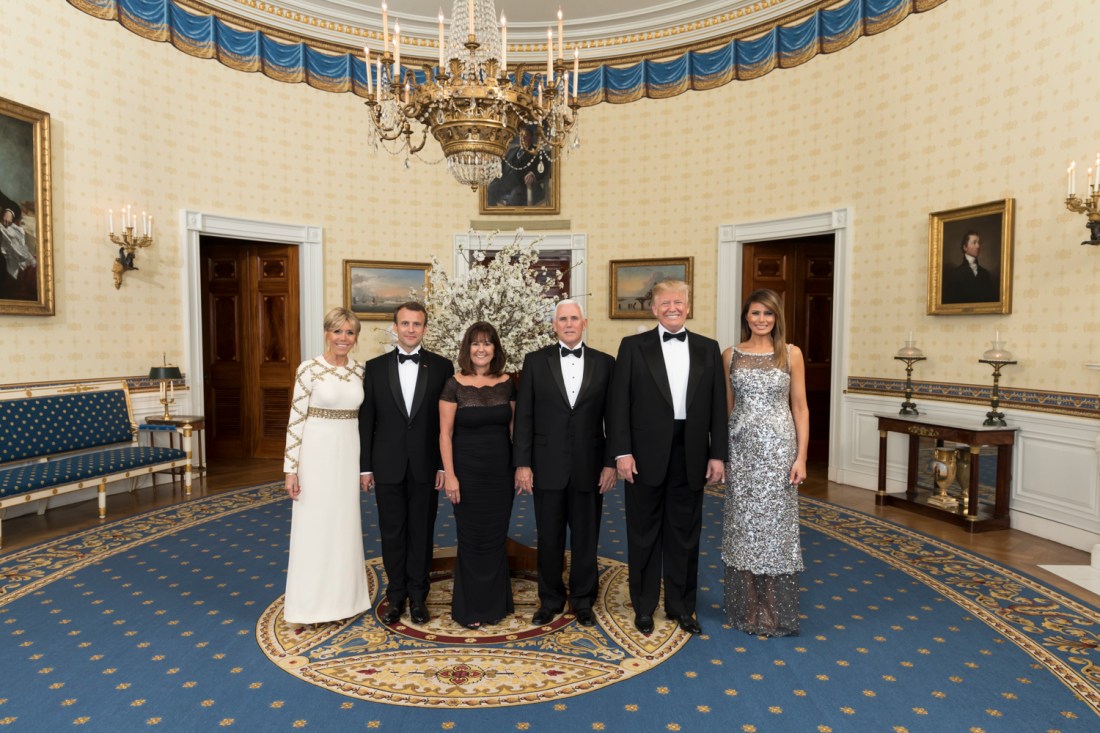
I mention this here because in a sense, Melania Trump’s fashion choice for the recent state dinner honouring France (wearing ‘a Chanel haute couture gown with black Chantilly lace, … hand-painted with silver and embroidered with crystals and sequins’) repeated this move: France will not be absorbed into US space; culturally at least, France remains a power to be recognised and honoured.

State_Dinner_-_The_Official_State_Visit_of_France_(26832278157) Copyright: The White House via Wikimedia Commons

There is an also an interesting difference here: Ms Obama wore the gown of an English designer for a Chinese state dinner, emphasising the globalisation of the fashion industry, while Ms Trump articulated a more ‘direct’ signifier: Chanel as an expression of French haute couture. Perhaps it symbolised the ‘special relationship’ between France and the USA that the current president mentioned during the state visit. I am not quite sure how to interpret that, any suggestions are welcome.

And then there was of course The Hat.

Arrival_Ceremony_-_The_Official_State_Visit_of_France_(41699693771) Copyright: The White House via Wikimedia Commons

A lot has been made of it by the crowd of fashion writers, hungry for a rebirth of White House sartorial spectacle ever since Michelle Obama left the White House. It was ‘a diva crown. A grand gesture of independence. A church hat. The Lord is my shepherd. Deliver us from evil. Amen’.

What is interesting in the context of my theory of fashion diplomacy is that the hat was commissioned by Hervé Pierre, the French-American designer of her inauguration gown. Here, then, Ms Trump repeats Ms Obama’s fashion diplomacy, if in a more limited fashion: the pencil skirt and jacket were designed by one of the most recognisable American designers, Michael Kors.

But back to The Hat… Channelling Beyoncé? Or Michelle Obama via Beyoncé? Or perhaps it reflected the way a former model deals with and processes her current position as First Lady. Writes Givhan,

the first lady sometimes appears to be dressing for a fashion-shoot version of the event — a kind of heightened reality of an already rather surreal circumstance. But there is also the sense that she is stubbornly and confidently dressing up and refusing to relax into today’s accepted decorum.

But then there is the colour of The Hat and the jacket and pencil skirt: a bright white. This, perhaps is the most dramatic statement, whether intentional or not: Ms Trump’s desire to present herself as pure and untainted by the ‘swamp’ her husband and current president is creating. In Vanessa Friedman’s words,

she has something of a history of using white suits to send what seem like fairly pointed messages; see her decision to wear white — associated with women’s rights in the form of the suffragist movement, as well as Hillary Clinton — to her husband’s first State of the Union address, which happened to be her first high-profile appearance with him after the Stormy Daniels scandal broke.

So the personal becomes the political, delivering a sartorial condemnation of inappropriate conduct that indeed, as suggested above, has religious undertones. And this of course adds yet another layer to the fascinating topic of ‘fashion diplomacy’.

Mr Zuckerberg Goes to Washington (Part 2: On Wide Collars and Crooked Ties)

Mark Zuckerberg’s testimony in the Senate and House of Representative meetings on 10 and 11 April have been covered extensively; what interests me here is a) the sartorial performance of Mr Zuckerberg himself, and b) the very interpretations of Zuckerberg’s performance by the fashion experts in the newspapers I mentioned in the previous blog. In other words, I am deploying a ‘double hermeneutics’ here that examines the meaning given by critics and commentators to the meaningful conduct by socially situated actors – in this case, Mr Zuckerberg in the Congressional hearings. To complicate matters further, I add a third level of analysis, that of the sartorial item in question itself and the social lexicons they mobilise. These three levels of analysis are then: the connotative code of the garment and the lexicons it mobilises, the vestimentary code the experts and critics refer to when explaining and ‘politicising’ particular sartorial performances, and the metalanguage of the social scientist (that would be me in this case) that communicates the inter-linked operation of the first two codes. All this builds on the semiotic theory of Roland Barthes, and I try to explain this a bit more extensively in a chapter on ‘Reading the Signs of Fashion’ in the forthcoming book on How to do Popular Culture in International Relations (Routledge 2018) edited by Mark Salter and Sandra Yao. In the following, I focus on the articles written by, and the vestimentary code deployed by, Robin Givhan of the Washington Post, and Vanessa Friedman of the New York Times.

Both Givhan and Friedman interpret Zuckerberg’s suit as a dress expressing ‘penance’ and ‘submission’. The suit, both fashion experts agree, becomes a ‘hair shirt’, sartorially supporting his apologies and promises of atonement. In Givhan’s words,

Zuckerberg did not look at ease. … He did not have the demeanor of the smartest and most impressive guy in the room. He looked like a 33-year-old man burdened with having to explain technology to legislators who are more than twice his age and don’t really want to hear about how users can change their settings; they just want him to fix what’s wrong with the damn thing.

Vanessa Friedman further contextualises Zuckerberg’s sartorial performance and the signification of the suit by pointing to the signified ‘seriousness’ and ‘business’ that were mobilised by Zuckerberg before.

This was not, of course the first time Mr. Zuckerberg has worn a suit. It’s just that it is seemingly possible to count on two hands the times he has done so: always on public occasions and (not counting his wedding) always when heads of state or other dignitaries are involved.

And she points to the already mentioned conscious sartorial strategy that he employs: to wear a tie to indicate the seriousness of his commitment to making Facebook a success in 2009. Both Givhan and Friedman therefore accept that Zuckerberg ‘kowtows’ to Congress. And this is certainly a valid interpretation that re-establishes the authority and the dignity of Congress and puts him into his proper place.

I would beg to differ, though.

Continue reading “Mr Zuckerberg Goes to Washington (Part 2: On Wide Collars and Crooked Ties)”

Mr Zuckerberg Goes to Washington (Part 1: On Grey T Shirts and Blue Suits)

Last week, the CEO of Facebook, Mark Zuckerberg came to Washington, DC, to give testimony in two Congressional hearings about all things Facebook. As I expected, the fashion experts and critics of the Washington Post, New York Times and other publications (including, interestingly enough, VOGUE) stepped up to the plate and reviewed his sartorial performance in the hallowed chambers of Congress. Equally predictable perhaps were some of the responses to these reviews and their all too common and familiar dismissal of fashion as a relevant social phenomenon. To cite just some examples, Robin Givhan, the fashion critic of the Washington Post, received the following comment on her Twitter account:

@maryguiden commented ‘Usually ❤️ reading @RobinGivhan but this seems like a personal attack. Why take @Official_Markfb to task for wearing what you deem is an ill-fitting suit? And because he’s not playing into “political theater”? #smh’.

@UAJordan1997 contributed @NPR@RobinGivhan Just spent 10 minutes discussing Zuckerberg’s suit. THIS 👏IS 👏NOT 👏NEWS’, following it up with ‘You’ve reduced arguably the biggest issue facing us today to a story about a crooked tie. That’s not an angle that deserves primetime news’. Continue reading “Mr Zuckerberg Goes to Washington (Part 1: On Grey T Shirts and Blue Suits)”